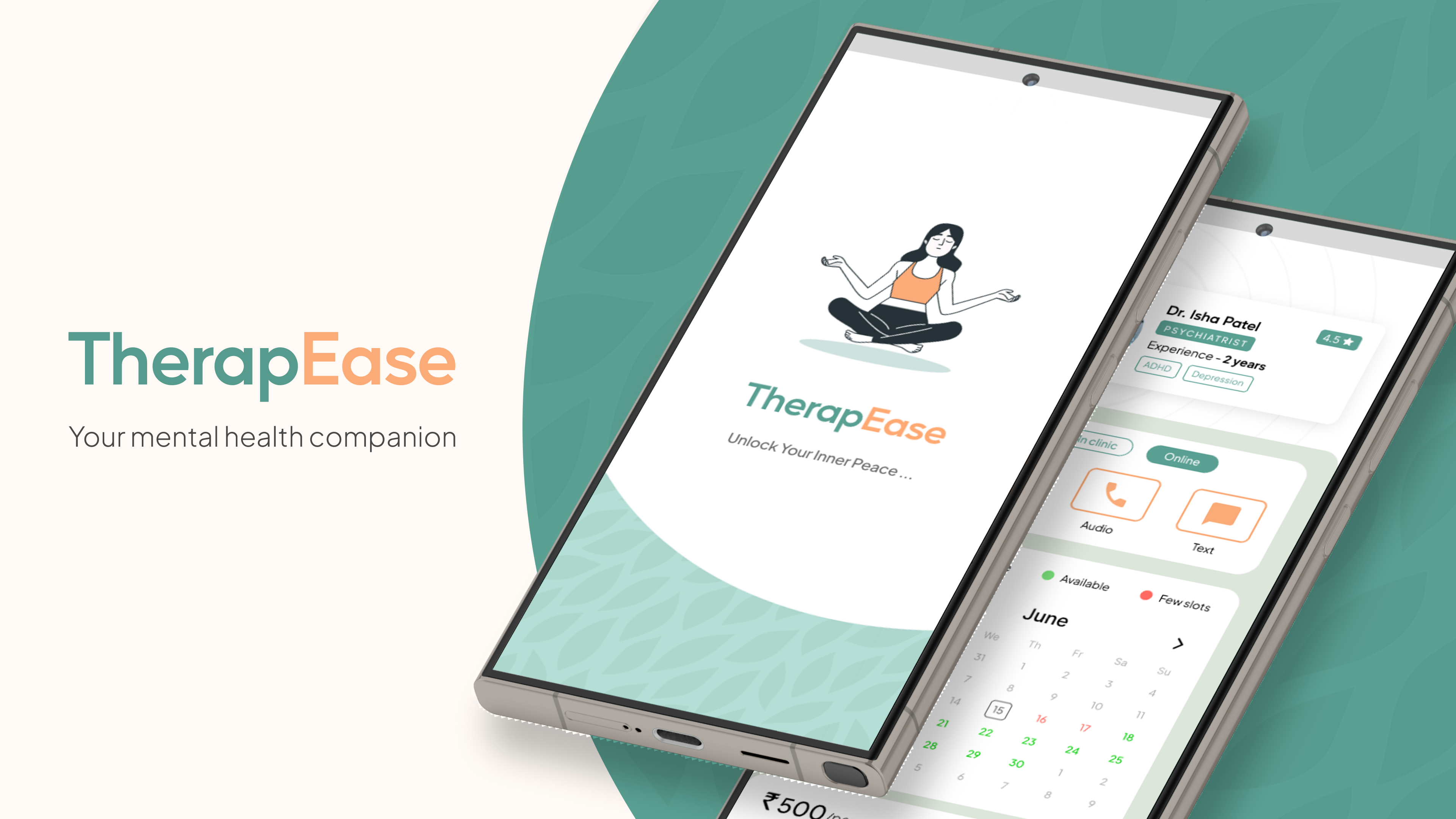
Designing a therapy-booking app for India, where 80% of people who need mental health support never seek it. From market research and user surveys to branding and a full app design.
RoleEnd-to-end: research, branding, UI/UX
Duration2 weeks
ContextSelf-initiated
PlatformMobile (Android/iOS)
ToolsFigma
Problem
India carries 15% of the global mental health burden with 0.75 psychiatrists per 100,000 people — and stigma, cost and sheer difficulty of finding the right professional keep 80% of sufferers from seeking help.
Solution
An app that meets people wherever they start — whether they know what they're dealing with or not — and guides them to the right professional through education, guided assessment, and trust-first booking.
Grounding
Built on teardowns of 6 competing platforms (features, pricing, review mining), a user survey, a persona and journey mapping — with every design decision traceable to a research finding.
01
The problem
Mental health support in India is scarce, stigmatised and hard to navigate. People experiencing symptoms are often labelled rather than helped; those who do decide to seek support face a fragmented landscape where finding a legitimate, affordable, relevant professional is a project in itself. The brief: design an app that lowers every one of those barriers.
1 in 8people worldwide live with a mental health disorder
80%of India's population do not seek help
0.75psychiatrists per 100,000 people — vs 3 recommended
+25%increase in mental health cases in India post-Covid
Mental health in India, in numbers
1 in 8 people worldwide live with a mental health disorder
15%of the global mental health burden is carried by India
25%rise in cases in India since Covid
80%of affected Indians never seek help
5.6 crorepeople in India live with depression
3.8 crorepeople in India live with anxiety
$1.03 trillion — estimated economic loss in India attributed to untreated mental health conditions
Framing the scale of the problem
02
Research & key insights
I tore down six platforms across India and the US — Practo, Mindpeers, YourDOST, Amaha, Talkspace and BetterHelp — comparing features, pricing models and hundreds of app-store reviews. Alongside, I ran a user survey and synthesised a persona and journey map to understand why people stall on the path to therapy.
Six platforms, two markets
India
Practo
Mindpeers
YourDOST
Amaha
Global / US
Talkspace
BetterHelp
Six platforms, two markets
Feature comparison across six competitor platforms
Feature
Practo
Mindpeers
YourDOST
Talkspace
BetterHelp
Amaha
In-person consultations
✓
✓
Voice-call consultations
✓
✓
✓
✓
✓
Video-call consultations
✓
✓
✓
✓
✓
✓
Chat-based consultations
✓
✓
✓
✓
✓
Forums
✓
✓
Group therapy
✓
✓
Games
✓
Tools
✓
✓
Articles
✓
✓
✓
✓
Assessment tools
✓
✓
✓
✓
Journal
✓
✓
✓
User insights
✓
✓
Venting section
✓
Medicine shopping
✓
Short courses
✓
AI chat bot
✓
Feature matrix: where the gaps are
PractoIndiaGeneral-healthcare marketplace — the only competitor with true in-person visits+
Does well
Huge doctor network with clinic, video and in-person booking in one flow
Full healthcare stack — medicines, lab tests, records — keeps users in one ecosystem
Falls short
Mental health is a side category, not the product
Review credibility is shaky — users report sponsored placements and moderated negative reviews
No-refund policy and unhelpful support erode trust at the worst moment
→ What TherapEase took: In-person options matter — our persona books offline when it isn't urgent — but trust signals have to be real. TherapEase pairs both modes with verified, transparent professional profiles.
MindpeersIndiaMental-health-first and engagement-led — games, venting, insights+
Does well
Affordable entry with guided therapist matching that users genuinely praise
Engagement layer — games, venting space, user insights — supports people between sessions
Falls short
Intake assessments box people into rigid categories; users call them reductive
Sign-up friction (no social login) and payment glitches right at the moment of commitment
→ What TherapEase took: Assessment should open doors, not label people — TherapEase's guided assessment routes users to the right professional without forcing a self-diagnosis.
Pricing — ₹1,800/session · ₹5,400 for 4 · ₹10,800 for 7
→ What TherapEase took: Be upfront about cost before people invest effort — TherapEase surfaces pricing on the professional's profile, before booking begins.
YourDOSTIndiaAccessible counselling with forums and articles, often via institutions+
Does well
Warm, empathetic counsellors with consistently strong ratings (4.4–4.5)
Decently priced, with heavy first-session discounts lowering the barrier to start
Falls short
Membership is required before you can even browse psychologists
One price across chat, audio and video feels unfair; connectivity glitches and thin late-night support
Pricing — first 45 min: chat/voice ₹1,299 · video ₹1,499 · unlimited chat from ₹1,899 / 2 weeks
→ What TherapEase took: Never paywall discovery — TherapEase lets people fully evaluate a professional before any money changes hands.
TalkspaceUSASubscription-therapy pioneer — asynchronous messaging plus live sessions+
Does well
Flexible modes — messaging-first plans, live video, workshops — under one subscription
Mature assessment and matching machinery
Falls short
Pricing feels vague and promo-driven; users describe onboarding as robotic
A professional's real availability is hidden until after you commit; matching loops surface near-identical profiles
→ What TherapEase took: Product quality is the moat — great clinicians can't save a broken app. TherapEase treats booking, journaling and video stability as core design surfaces, not plumbing.
Per-platform teardowns — features, review mining and pricing behind the matrix
01
The barrier isn't demand — it's trust and navigation
Survey respondents cited cost (56%), difficulty finding the right therapist (56%) and stigma as their main blockers. Open answers went further: "Will I get real help?", "Who dictates that these therapists are trauma-informed?" People wanted queer-affirmative, localised, credible care — and no platform was signalling it convincingly.
02
Credibility signals decide the choice
When choosing a therapist, users weighted specialisation (87.5%), fees (69%) and reviews/recommendations (62.5%) far above everything else. Detailed professional profiles were the single most-wished-for feature — ahead of booking convenience itself.
03
Two very different starting points
Some users arrive knowing exactly what they're dealing with; many others only know something is wrong. A journey map traced how confusion and self-diagnosis in the awareness phase caused people to stall before ever reaching a professional — the app had to serve both mental models from the first screen.
RD
Riya Dutta
23 · Mumbai · Software engineer
Spends her free time on OTT platforms and social media. Books her therapist through an app.
"If it's urgent I'll book an online consultation — otherwise in person."
Says
Onboarding is too long
Books online or in-person depending on urgency
A professional's calendar would help her plan
Journaling helps pinpoint the root cause
Does
Researches therapists based on her requirement
Reaches out to the therapist in-app
Chooses mainly on cost and years of experience
Thinks
Only found the problem after awareness
Finding a professional is trial and error
Audio, video and interface could be better
Feels
Therapy is costly
Really benefited from journaling
Finding a good professional is tedious
Better after therapy
Persona & empathy map
Customer journey map across four phases
Phase
Awareness
Research
Selection
Dealing
Task
Looking for symptoms / self-diagnosis
Finding a solution
Selecting a professional
Going for therapy
Emotion
Confused · Anxious · Uncertain
Indecisive · Doubtful
Hope
Satisfied · Improving
Pain points
Choosing an application · Uncertainty
Whether the professional is legit
Onboarding · Scheduling · Evaluation
Interface
Opportunities
Information about disorders
More info about professionals · Pricing
Onboarding · Scheduling · Evaluation
Interface · Scheduling
Journey map: where people stall
"People weren't refusing therapy. They were getting lost — between not knowing what they had, and not knowing who to trust."
03
Design decisions
Every decision below maps back to a research finding: reduce the navigation burden, surface credibility, and never assume the user knows their diagnosis.
Decision 01
Two entry paths from the very first screen
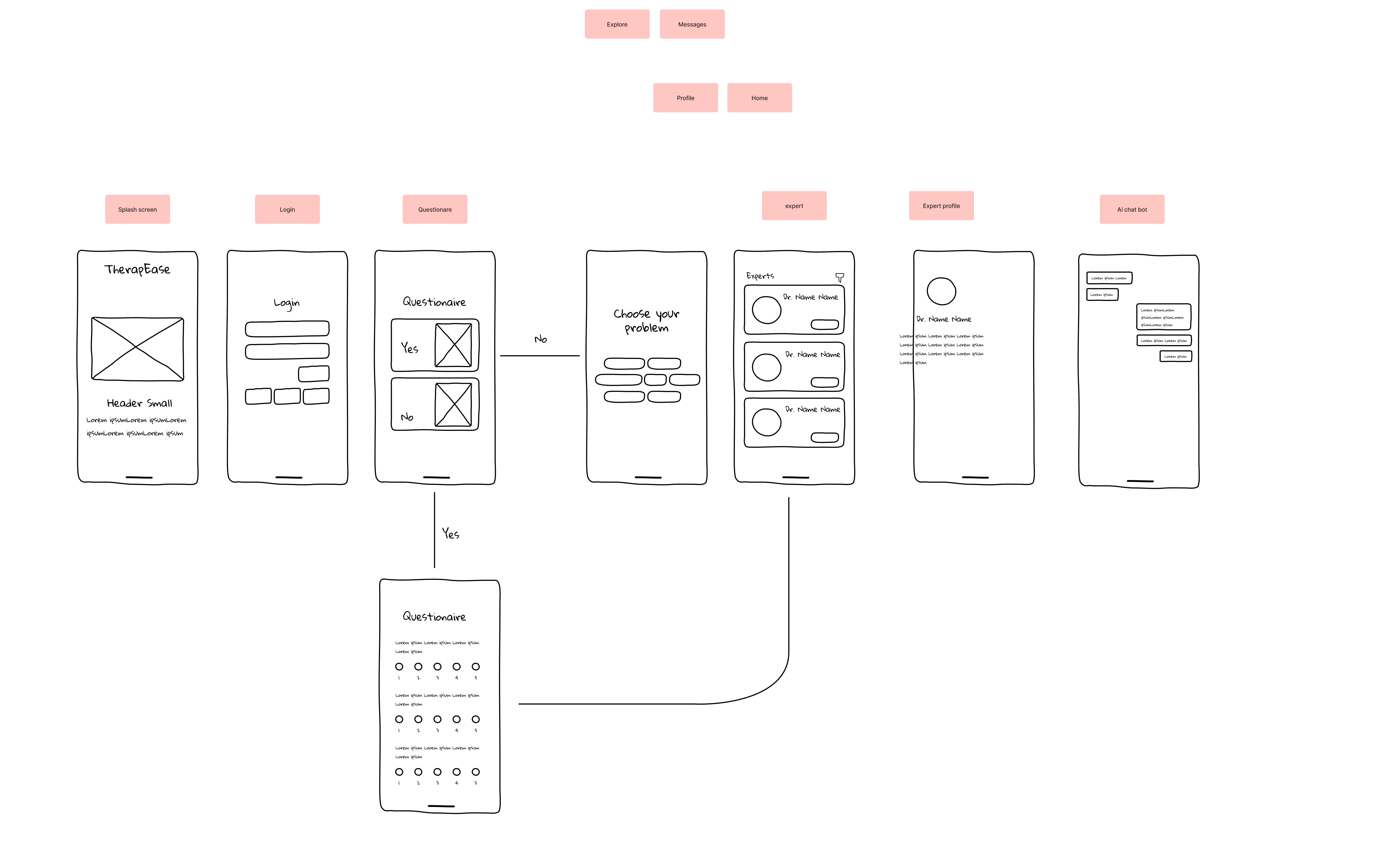
Onboarding forks on one honest question: "I know what my issues are" vs "I don't know what my issues are." The first path goes straight to concern selection and expert browsing; the second runs a guided, DASS-inspired questionnaire that translates how someone feels into the concerns they can get help for.
This mirrors a principle from my quantum computing thesis: when users bring fundamentally different mental models, don't average them — design for each and bridge them.
Low-fi: the forked onboarding flowDecision 02
A taxonomy that routes disorders to the right professionals
Research showed people don't know the difference between a psychiatrist, psychologist and counselor — a real cost when the wrong booking wastes money and hope. I mapped disorder categories to the professional types qualified to treat them, so matching happens under the hood: users pick what they're feeling, and the app filters who can actually help.
The routing logic behind matching — each cluster maps to the professionals qualified to treat itDecision 03
Trust-first professional profiles
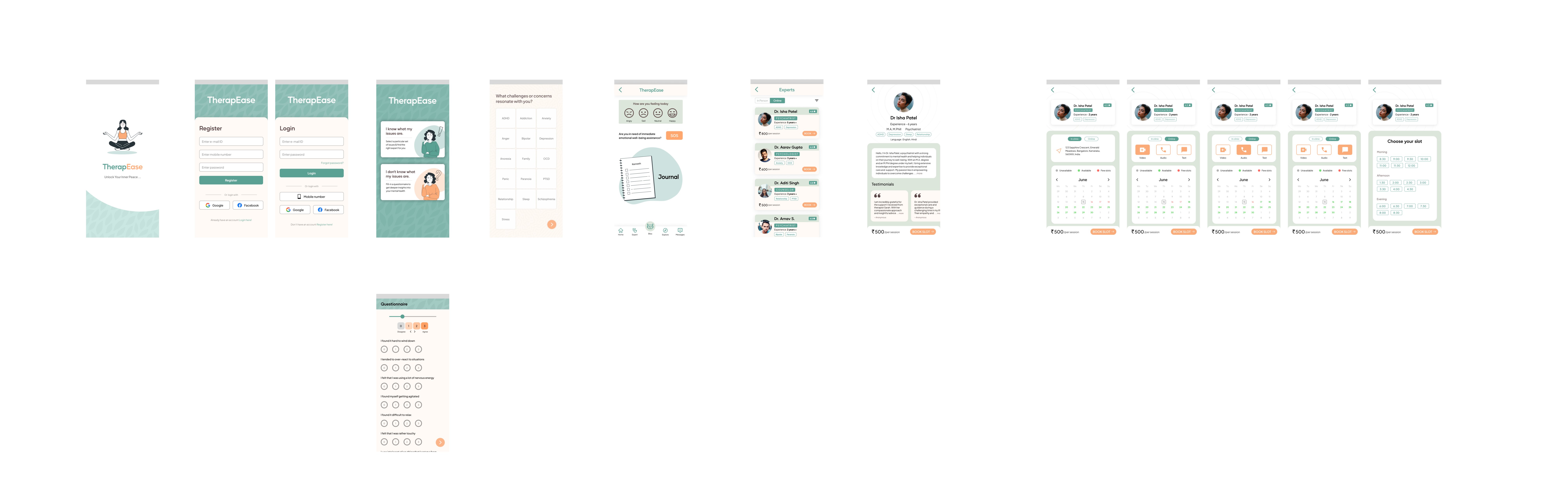
Because credibility decides the choice, profiles lead with qualifications, specialisation tags, years of experience, testimonials, transparent per-session pricing and a live availability calendar — the exact criteria users said they judged by. Booking sits at the end of the credibility story, not before it.
Stigma and access shaped the consultation model: in-clinic or online, and online via video, audio or text. For a first-time user in a small city — or anyone not ready to say things out loud — text-first therapy is the difference between starting and not starting.
Decision 05
A support layer between sessions
Ideation included a journal (optionally shareable with your professional), daily goals, an SOS action, and an AI companion chatbot — because care shouldn't only exist inside a booked slot.
Next iteration — in progress
I'm currently deepening the AI companion and SOS flow: when a conversation should escalate to crisis support, when the bot must hand off to a human professional, and how it avoids overstepping in a vulnerable context. This is the design problem I find most interesting in 2026 — AI in high-stakes, trust-critical products.
04
Craft: building the visual language
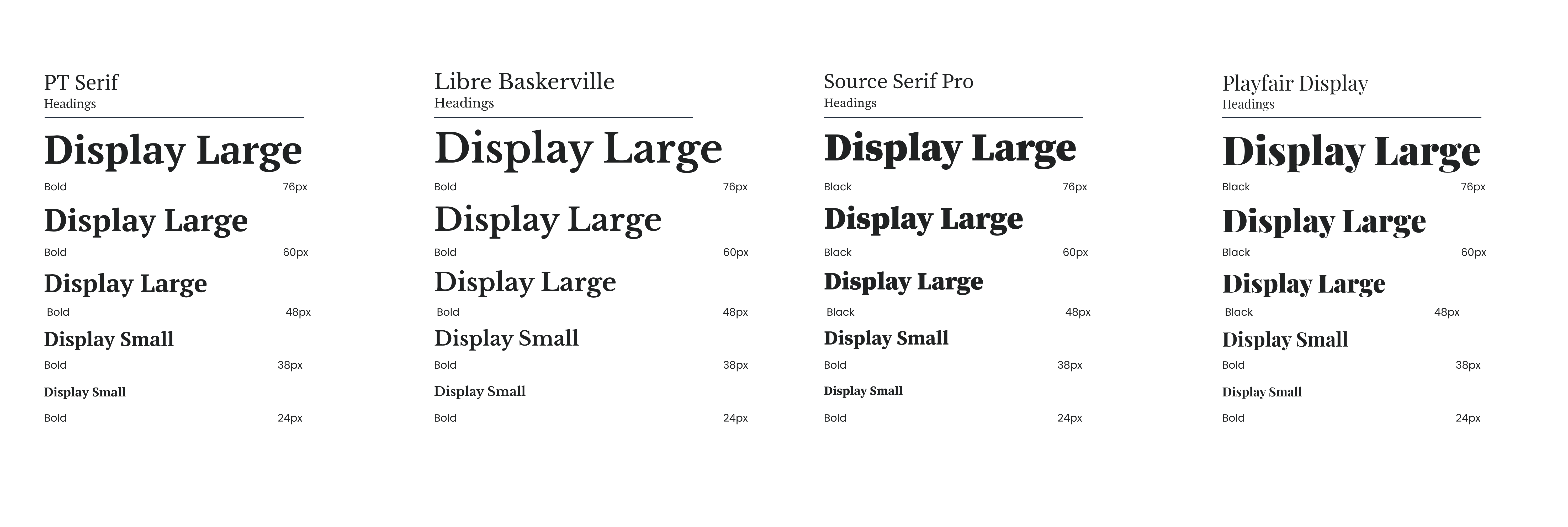
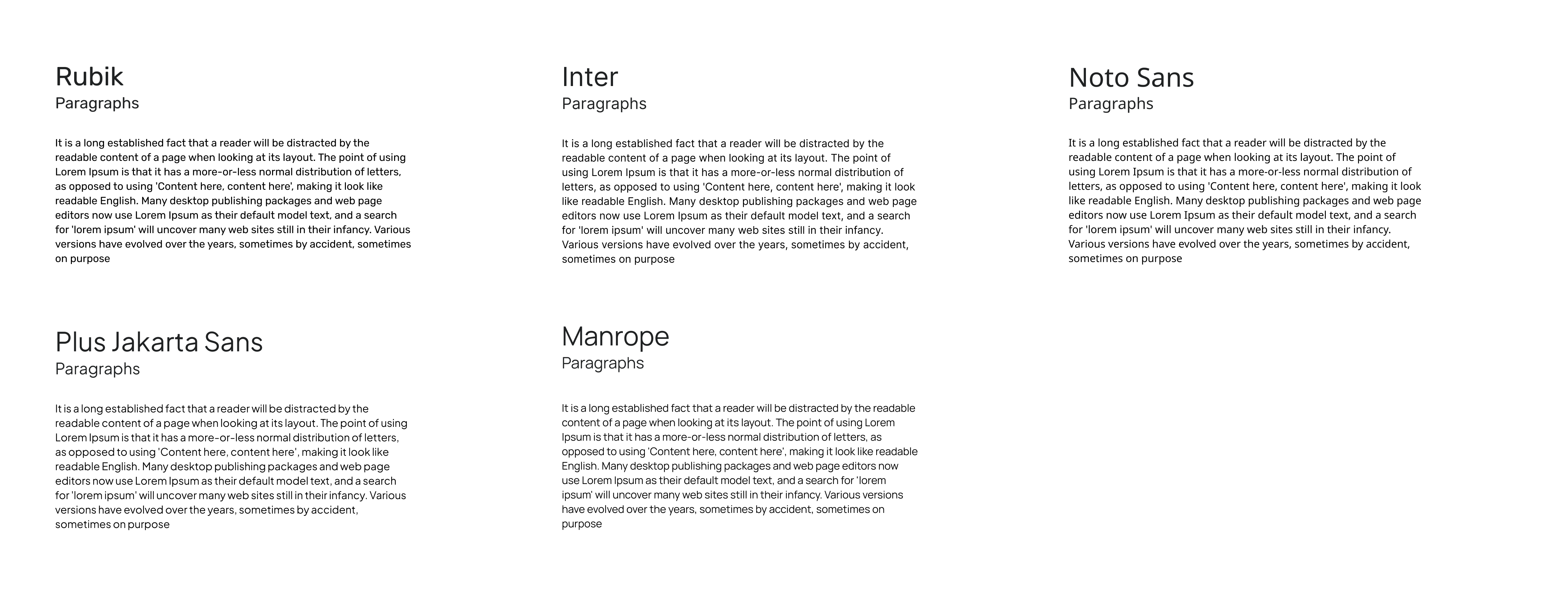
The brand needed to feel calm without feeling clinical, and warm without being childish. I explored four serif and five sans-serif directions and six palettes before landing on Mustica Pro with Plus Jakarta Sans, on a muted teal with a warm orange accent — composed enough for a healthcare context, human enough for a hard first step.
Heading explorations
Body explorations
TherapEase design language
HeadingsMustica ProSemi Bold · 48 / 32 / 22 / 20 / 16px — live specimens in the hi-fi screens below
BodyPlus Jakarta Sans
Warm, quiet and legible at every size — the body face carries assessments, profiles and booking without raising its voice.
#594545 Cocoa
#FFFAF5 Cream
#FAAB78 Peach
#DDE6DB Mist
#5AA093 Teal
#00CC00 Green
#FF6961 Coral
The final style guide
05
Where it stands & reflection
TherapEase is a research-grounded concept I designed end-to-end as a self-initiated project — the full flow exists in hi-fi, validated against competitor gaps and survey findings. The honest next step is usability testing on the questionnaire path, and building out the AI companion's escalation logic.
What this project taught me: in trust-critical products, the interface is the smallest part of the design. The real work was the routing taxonomy, the credibility architecture of a profile, and respecting that a user's first step into therapy might need to be a silent, text-based one.